
“Our innovations are created at the intersection of data, technology, media and client understanding,” says Patrick Becker, Managing Director of moccamedia.
In an interview with ONEtoONE, the trade magazine for new marketing management, he explains why innovative strength in SMEs is no accident, what structures moccamedia has created for it – and why new ideas only really count when they deliver measurably better results for clients.
ONEtoONE asked these questions on the occasion of the TOP 100 innovation competition, whose award went to moccamedia again a few days ago at the German SME Summit.
26 June 2026 – In 2026, moccamedia is once again among the leading group of TOP 100 innovators in Germany and has also been named “Leading Innovator 2026” by FOCUS Business. In the interview, Managing Director Patrick Becker explains why innovative strength in SMEs is no accident, what structures moccamedia has created for it – and why new ideas only really count when they deliver measurably better results for clients.
by Dominik Grollmann
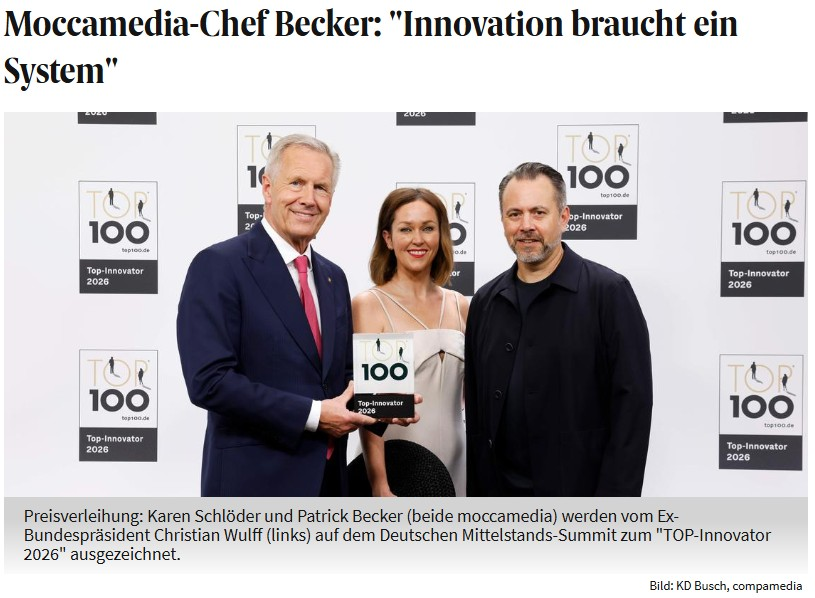
Today, moccamedia is being honoured as a TOP Innovator 2026 at the German SME Summit in Heidelberg by former Federal President Christian Wulff (who is also the mentor of the innovation competition) – for the second time after 2018. In the scientifically supervised benchmarking, the media and MarTech agency achieved top marks and ranks among the top 10 of the competition overall. In 2026, moccamedia is thus once again one of Germany’s TOP 100 innovators and has also been named “Leading Innovator 2026” by FOCUS Business.
According to the owner-managed media and MarTech agency, innovation is not a one-off project but a firmly anchored part of its corporate strategy: from the systematic collection of ideas and its own innovation committee to the development of new data-driven solutions for regional, sales-oriented communication. In the interview, Managing Director Patrick Becker explains why innovative strength is no accident, what role processes, top management and openness play – and why new ideas only count when they deliver measurably better results for clients.
Congratulations on the double award for moccamedia. How do you become an outstanding innovator in the industry?
Patrick Becker: It takes a well-thought-out package of measures that specifically initiate and drive innovation, and you have to anchor the topic in the company’s DNA. In practice, this means for us: we continuously monitor changes in technology, media usage and retail and constantly develop new solutions from them. We have the advantage that, as an independent, owner-managed company, we can decide and act very quickly. This combination of openness, speed and strength in implementation is what makes us innovative. This is also confirmed by the current TOP 100 innovation assessment. It awards us top marks and a level of innovation well above the average of the TOP 100 companies.
Can you be more specific? What concrete structures, processes or routines have you created to systematically promote innovative thinking?
Innovation needs a system. This includes clear responsibilities, time to develop, evaluate and test new ideas, and the willingness to try things whose outcome is not yet certain. We regularly discuss developments in the management team and include different perspectives from our teams. To this end, we have established our innovation committee and built our own database, among other things. There we document and evaluate all of our employees’ ideas. The management gives feedback on every new suggestion for improvement within about 10 days, rewards promising approaches with bonuses and develops them further systematically. Innovation is an integral part of our corporate strategy. In 2024 alone, we spent almost one million euros on innovation activities. Our aim is to turn ideas into pilot projects and marketable solutions as quickly as possible.
In top management, at least 50 percent of working time is reserved for innovation. Does that mean innovation has to be introduced top-down?
Top management has to set an example and give innovation priority. If the company’s management provides neither time nor resources for it, innovation usually remains a matter of chance. At our company, the management reserves around 50 percent of its working time for innovation topics. At the same time, it deliberately delegates responsibility and freedom of decision to those who lead innovation projects.
Everyone who works at moccamedia can initiate innovation. Ideas often arise where people work close to clients, media partners or technological systems. That is why we see innovation as an interplay: management sets the direction and framework, and the impetus comes from the entire company. Short decision-making paths are important. When employees experience that their ideas are heard and evaluated quickly, initiative follows.
What talents and skills does a company need to remain capable of innovation: creative lateral thinkers, data-driven analysts, technological specialists – or people who combine all of these?
Diversity is crucial: creative people ask new questions and think in terms of possibilities. Analysts recognise patterns and can assess potential. Technological specialists know what is feasible today and tomorrow. Many of our innovations are created at the intersection of data, technology, media and client understanding. That is why we deliberately promote collaboration between departments and rely on different educational backgrounds and internationality. And we deliberately create an environment in which unusual perspectives and unconventional ideas are welcome.
Prizes and awards are an honour – but you can’t buy anything with them. Is your innovation work ultimately rewarded by clients? For example, through higher budgets, longer relationships or greater trust?
Absolutely. Innovation is not an end in itself for us. Our clients expect solutions that make regional communication more effective and efficient. When we develop new ad formats, new data models or new technology-based solutions, it is always about increasing demand and sales at local points of sale. The fact that many clients have been working with us for years and keep exploring new paths with us shows that they see the results – and that creates trust.
moccamedia describes itself not only as a media agency, but as a data-driven media or MarTech company. What do you do differently from traditional media agencies?
Many agencies use existing ad formats. We repeatedly develop new opportunities for regional communication ourselves, often very close to the client. That sets us apart from many competitors. We see ourselves as a MarTech company that brings together data, technology and regional market knowledge gained over many years. This results in new ad formats, data models or local control options, which we often continue to optimise together with partners.
How long have you worked on building this capacity for innovation?
The capacity for innovation does not develop in two or three years. We have been working on it for more than 30 years. Of course, not every idea succeeds, and not every technological development unfolds as expected at the outset. That is part of it. What matters is learning from it and keeping the courage to carry on. Our advice to other SMEs is therefore to see innovation as a continuous learning process. Those who anchor this systematically in the company and give people the freedom to try new things lay the foundation for lasting innovative strength.
The interview was published on 26 June 2026 by ONEtoONE, the trade magazine for new marketing management, and also appeared at the same time in the news feed of the future research think tank iBusiness.